The nastiest failure in a lazy-loaded PWA is not a crash inside React. It is the blank screen that appears before the app has even loaded. After a release the entry script never arrived, a dynamic import() returned 404 for a hash that no longer exists, the Service Worker handed back a stale index.html, or the CDN served a cached copy — and the user is looking at nothing. Sentry is silent, because execution never reached your ErrorBoundary.
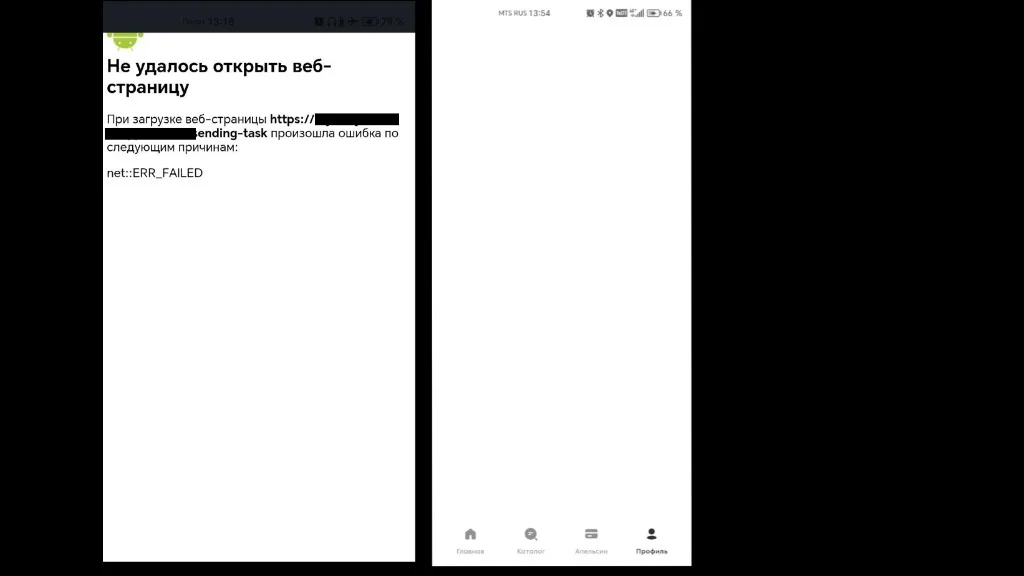
With code splitting and content-hashed chunks, this is not an exotic edge case. It is the expected state of the world right after a release, and it lasts longer than you think in a WebView, where a tab can stay alive for days. Without a static fallback the user gets either the system WebView error net::ERR_FAILED or a white screen of death — the native wrapper with its tab bar is already there, but the content never arrives:
Three layers go around every app like this:
- a fallback that works with no bundle at all;
- runtime recovery that catches version skew once the app is running;
- telemetry for the Service Worker, without which recovery turns into magic.
First, a page that knows how to fail well
Until the JS bundle loads, nothing in your React stack can help you. So the lifeline lives directly in index.html: inline styles, plain text, and a tiny script with no dependencies.
Two hooks are usually enough. The first is onerror on the entry <script type="module"> — it covers being offline, flaky networks, VPNs, CDN trouble, and plain broken URLs.
The second is a short timer against an empty #root. Three seconds works well in the apps I run. If React has not mounted by then, treat the boot as failed. I deliberately avoid a global window.onerror across every script: a WebView generates far too much noise from code that isn't yours.
The behavior is deliberately dumb. Try a plain reload a few times. Once the budget is spent, show a static screen with honest copy and a single action — close or retry. Keep the attempt counter in sessionStorage under a neutral key like boot-retry-count, and use that same key in the in-app recovery path below. Otherwise the HTML and the bundle each run their own reload loop, and the user gets a refresh carousel instead of one coherent recovery cycle.
<main id="boot-fallback" hidden aria-live="polite">
  <h1>Couldn't load the app</h1>
  <p>Check your connection and try again.</p>
  <button type="button" id="boot-fallback-close">Close</button>
</main>

<div id="root"></div>
<script type="module" src="/assets/index.js" onerror="window.__bootFail?.()"></script>(function () {
const RETRY_KEY = 'boot-retry-count';
const MAX_TRIES = 3;
const WAIT_MS = 3000;
function tries() {
try {
return Number(sessionStorage.getItem(RETRY_KEY) || 0);
} catch {
return 0;
}
}
function fail() {
if (tries() < MAX_TRIES) {
try {
sessionStorage.setItem(RETRY_KEY, String(tries() + 1));
} catch {}
location.reload();
return;
}
document.getElementById('boot-fallback')?.removeAttribute('hidden');
}
window.__bootFail = fail;
setTimeout(() => {
const root = document.getElementById('root');
if (root && !root.firstChild) fail();
}, WAIT_MS);
// A successful mount resets the counter so the next visit starts clean
const root = document.getElementById('root');
if (root && 'MutationObserver' in window) {
const observer = new MutationObserver(() => {
if (!root.firstChild) return;
try {
sessionStorage.removeItem(RETRY_KEY);
} catch {}
document.getElementById('boot-fallback')?.setAttribute('hidden', '');
observer.disconnect();
});
observer.observe(root, { childList: true });
}
})();Inside a mobile WebView, the close button usually maps to a deeplink back into the host shell. The exact scheme depends on the app and its architecture; what matters is that this action also lives in the HTML rather than in the bundle that just failed to load. Instead of emptiness, the user gets a clear screen with retry or close:
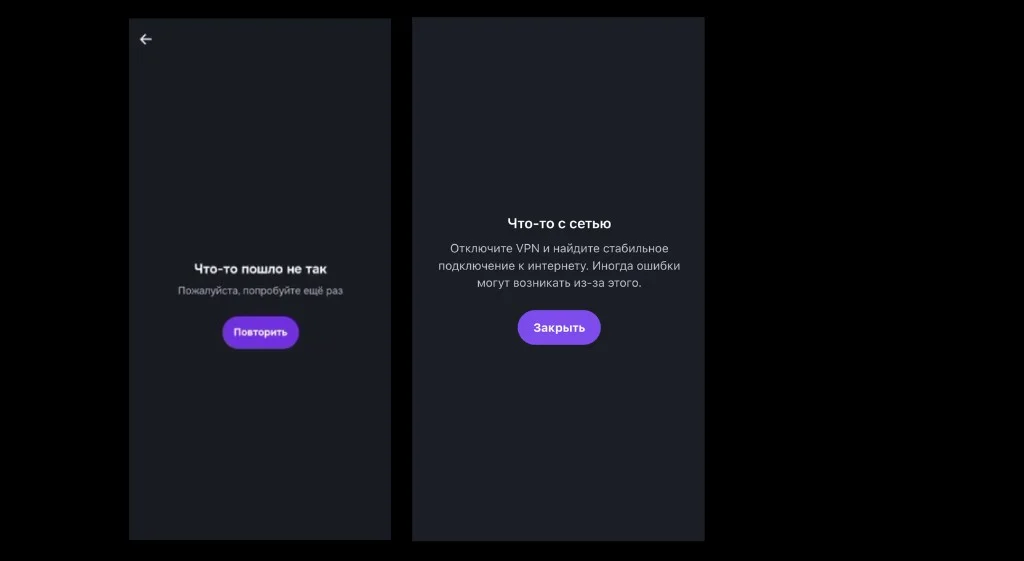
And I am convinced the feedback has to be direct, not veiled. Network trouble, something failed to load? Say exactly that — not the generic ErrorBoundary hook of "Something went wrong."
Then, recovery for when React is alive but the chunk is not
The classic post-deploy situation: the shell came up, the user clicked into a lazy route, and chunks/Feature-abcd.js is no longer on the CDN. Vite dispatches vite:preloadError, the import() promise rejects with something like Failed to fetch dynamically imported module, and sometimes preloaded CSS fails alongside it.
Here you can work from inside the bundle. Same idea as the static fallback, but with more judgment:
- First attempt is a soft
location.reload(). That is often enough when it was just a cache race. - If that didn't help, check whether the origin or CDN is actually reachable — not via
navigator.onLine, which lies, but with a real network probe. Only then cache-bust: force a fresh document with a query parameter like?fresh=<timestamp>. - If there is no network at all, do another soft reload and absolutely no wholesale wipe of
CacheStorage. Clearing caches "just in case" is the surest way to destroy offline support for someone who is already on a bad signal.
Worth knowing: Firefox once shipped a forceGet argument to location.reload() for exactly this, but nothing else supports it. A location.replace() with a changed query string is the portable answer.
const RETRY_KEY = 'boot-retry-count';
const FRESH_PARAM = 'fresh';
const MAX_TRIES = 3;

const CHUNK_HINTS = [
  'Failed to fetch dynamically imported module',
  'Importing a module script failed',
  'ChunkLoadError',
  'Unable to preload CSS for',
];

function looksLikeChunkError(error: unknown): boolean {
  const message = error instanceof Error ? error.message : String(error ?? '');
  return CHUNK_HINTS.some((hint) => message.includes(hint));
}

function tries(): number {
  try {
    return Number(sessionStorage.getItem(RETRY_KEY) || 0);
  } catch {
    return 0;
  }
}

function bumpTries(next: number): void {
  try {
    sessionStorage.setItem(RETRY_KEY, String(next));
  } catch {}
}

async function originLooksReachable(): Promise<boolean> {
  if (!navigator.onLine) return false;

  const ctrl = new AbortController();
  const timer = window.setTimeout(() => ctrl.abort(), 3000);

  try {
    await fetch('/__connectivity-check__', {
      cache: 'no-store',
      signal: ctrl.signal,
    });
    return true;
  } catch {
    return false;
  } finally {
    window.clearTimeout(timer);
  }
}

function reloadWithFreshShell(): void {
  const url = new URL(location.href);
  url.searchParams.set(FRESH_PARAM, String(Date.now()));
  location.replace(url.toString());
}

async function recover(): Promise<boolean> {
  const next = tries() + 1;
  if (next > MAX_TRIES) return false;
  bumpTries(next);

  if (next === 1) {
    location.reload();
    return true;
  }

  if (await originLooksReachable()) reloadWithFreshShell();
  else location.reload();
  return true;
}
Wiring it up is the boring part, but it has to cover both the Vite-specific event and rejected imports that never reach a catch:
window.addEventListener('vite:preloadError', (event) => {
  if (looksLikeChunkError(event.payload)) void recover();
});

window.addEventListener('unhandledrejection', (event) => {
  if (looksLikeChunkError(event.reason)) void recover();
});
Two details I learned the hard way.
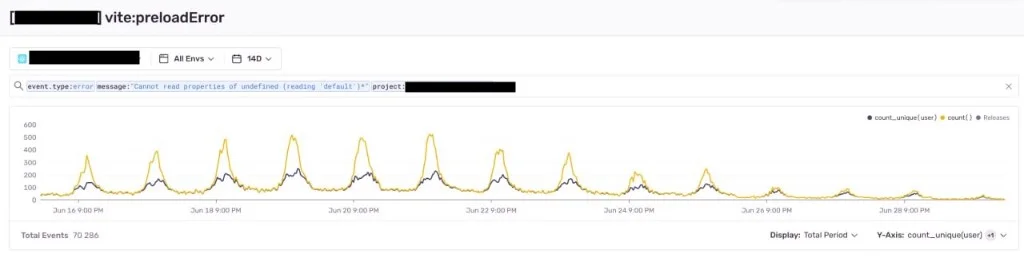
First: do not call preventDefault on vite:preloadError. In Vite that produces secondary failures along the lines of "cannot read property default of undefined" — the module error looks swallowed, while every importer is still sitting there waiting for an export. Let the error propagate; recovery only needs to kick off a reload.
Second: the Service Worker has to understand your cache-bust parameter. If the navigation handler always serves index.html from precache, ?fresh=… refreshes precisely nothing. Exclude the parameter both from ignoreURLParametersMatching, so precache doesn't collapse it back onto the plain URL, and from the SPA navigation fallback:
precacheAndRoute(self.__WB_MANIFEST, {
  // strip every query param except fresh — fresh has to change the match key
  ignoreURLParametersMatching: [/^(?!fresh$).+/],
});

registerRoute(({ request, url }) => {
  if (request.mode !== 'navigate') return false;
  if (url.searchParams.has('fresh')) return false; // go to the network for a new shell
  return true;
}, createHandlerBoundToURL('/index.html'));
Give the origin probe its own NetworkOnly route in the Service Worker: a short path like /__connectivity-check__, never cached. Keep navigator.onLine only as a cheap guard meaning "definitely offline, don't get aggressive."
While recovery is running, show a loader in your ErrorBoundary rather than an error screen, and don't report it to Sentry as a crash — it's a reload. Otherwise the dashboard fills with phantom failures every time you deploy.
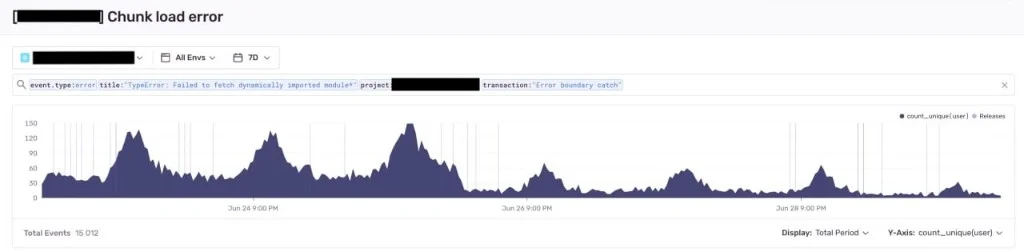
With this setup in place, Sentry shows post-release lazy-chunk errors dropping — both the secondary crashes from calling preventDefault on vite:preloadError, and the Failed to fetch dynamically imported module ones themselves:
CDN configuration stays critically important here: do not cache files like the service worker, HTML, and the manifest — give them no-cache and must-revalidate.
And separately, proof that the Service Worker is actually there
Recovery without observability treats symptoms you never see. The most useful sensor I add after SW registration runs a few seconds into the session — not immediately, or cold starts will produce false positives — and checks two things.
Is navigator.serviceWorker.controller present? If this isn't the user's first visit and there's still no controller, they are almost certainly living without the offline shell.
Is the shell document sitting in Cache Storage — say /index.html? Precache may have failed to install, the manifest may have filtered it out, or a quota eviction may have thrown the entry away.
window.setTimeout(async () => {
  const controlled = Boolean(navigator.serviceWorker?.controller);

  if (!controlled) {
    reportWarning('sw-missing-controller', { online: navigator.onLine });
  }

  if (!('caches' in window)) return;

  try {
    const shell = await caches.match('/index.html', { ignoreSearch: true });
    if (!shell) {
      reportWarning('sw-missing-offline-shell', { controlled });
    }
  } catch (error) {
    reportWarning('sw-cache-check-failed', { error });
  }
}, 5_000);
In Sentry this shows up as a dedicated diagnostics transaction — Offline shell is missing in cache and Service worker controller missing after startup:
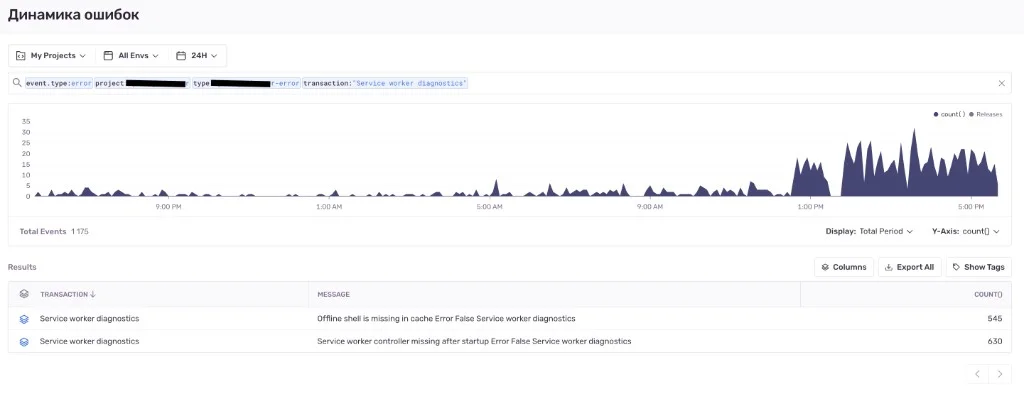
Attach the same context to lazy-route warmup errors and to SW registration failures: is there a controller, is the device online, what pathname, which recovery attempt. With that, your logs can tell apart "the network died," "the Service Worker hasn't claimed the page yet," and "the CDN is already serving a different version."
One caveat on that five-second timeout: it's an empirical number that comes from your own users, and it scales directly with what you put in precache. If the manifest covers the entire app and every chunk, the Service Worker may take 10 or 15 seconds to take control of the page.
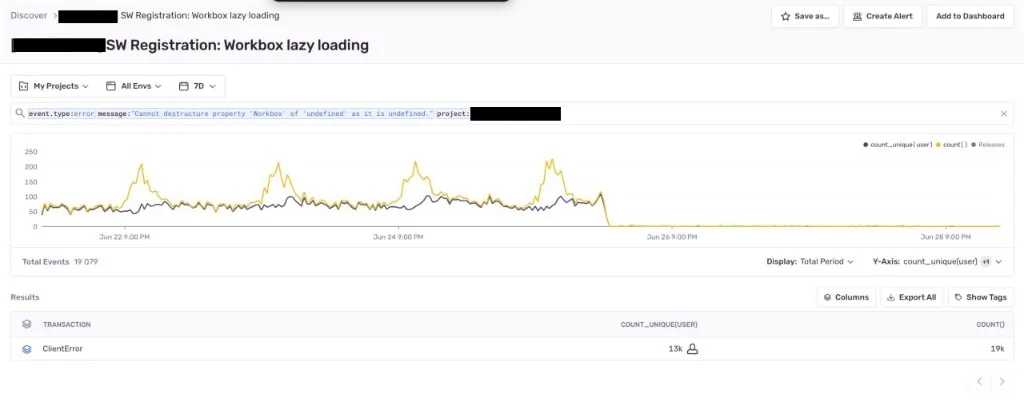
I wrap SW registration itself in a small retry with exponential pauses and log only the final failure. Intermediate attempts are ordinary mobile-network weather, not an incident. After careful lazy-loading of Workbox and registration retries, errors like Cannot destructure property 'Workbox' go to zero:
How it all fits together
First the entry fails or hangs, and the HTML answers before React ever runs. Then the app is alive but trips over a chunk that a release removed, and runtime recovery answers with a careful cache-bust of the shell. Running alongside both, once per session, you check whether the Service Worker has quietly gone missing and whether the offline shell is still in the cache.
None of these layers replace precaching the critical chunks described in the note on offline support and lazy loading. They cover something else: what happens once the ideal path has already broken.